Description
Australia’s Cypriot settlement is an important component of the national history of the Cypriot Diaspora and its study is justly popular. The struggles and achievements of hundreds of thousands of Cypriots and their impressive role and contribution in their host countries continue to rouse enthusiasm and excite interest.
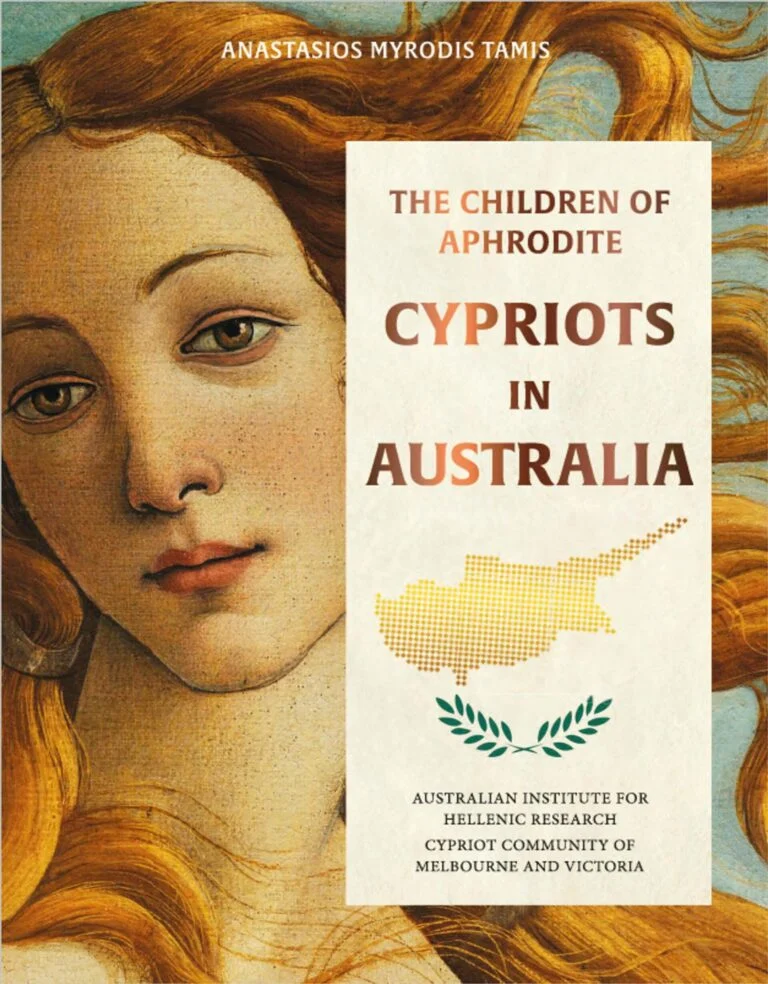
The aim of this book has been to investigate, document and analyse the archives, records, and memoire, as well as the chronicle of the Cypriot settlement experience in Australia, attempting to answer the question, “how did events develop in this way?” The book investigates the various stages of Cypriot settlement and presence in Australia, including the phases of settlement, socio-economic organization and mobility, cultural and inter ethnic relations, inter- and intra-communal politics on the Cyprus issue. Due attention is also given to the manifold and intensive socio-cultural and artistic expressions, as well as political and economic activity, by discussing their contribution and integration into the host societies while examining the parameters that led to their consolidation and integration into the local society. The importance and history of the Cypriot Community Organisations, especially in the major cities is extensively discussed and analysed. The notable contribution of Australias Cypriots was not creation ex nihilo but was due to their great zeal and endeavours over many years.
Although the exact date of the first Cypriot settlement in Australia remains rather nebulous, there is enough evidence to justify that the closing years of the nineteenth century were the initial years of settlement. It also appears especially imperative to note that the type, style, and motif of emigration of more than 300,000 Cypriots and their settlement in English speaking countries such as Australia, New Zealand, Canada, and the U.S, on a significant scale was also essential for those countries’ founding and development. Such migration was different to Greck migrations. Cypriots began emigrating prior to 1880 as curious seafarers, peripatetic fortune seekers and roving adventurers, After 1880, becoming British protectorate subjects, they discovered the shores of Australasia as chain-like invitees of preceded Cyptiots and later as refugees. Their subsequent settlement; being “non-immigratory” did not meet the intricacies nor the strictly political and socio-economic restrictions by which pre-WWII Greeks wete seriously affected. Moreover, many Cypriot settlers, upon arrival, were more familiar and better accustomed to the British-oriented socio-political environment in Australia.
Post-WWII Cypriot settlement in Australasia, which commenced in 1946, had been the precursor
-of the massive Greek migration which commenced six years later because of the bilateral Graeco Australian Immigration Agreement. During the 1920s, because of the imposed banning restrictions on the employment of non-British subjects, hundreds of pioneer Cypriot settlers, in the Australian outback in Western Australia and Queensland, welcomed stranded and unemployable Greek immigrants into their own labour consortia, introducing them to prospective employees as “Cypriots”. The ethnic, cultural, religious, and linguistic commonality between Greeks and Greek-Cypriots shaped the course of their evolution from migrant status to Australian citizens. These were the building blöcks of later generations that established the various communities that are extensively discussed and included the Cypriot Community of Melbourne and Victoria that had the vision to sponsor this book.
The typological designations of “Cyprian”
“Cypriot”, “Cypriote”, including the Homeric “Cypriotis” and
its female “Cypriotida”, can refer to the native or inhabitant of Cyprus or in the diaspora as a separate ethnic identity, The Children of Aphrodite; Cypriots in Australia is well accorded and justified given the ancient religion and civilization of the Cypriots.


